
Olmsted County Recent Arrest Records
One arrest in Olmsted County can leave several records behind. An officer writes the incident report, and jail staff open a booking entry at the Adult Detention Center when the person arrives. A court record may follow later. Rochester Police and the Olmsted County Sheriff both make arrests, and the Sheriff also provides contract policing in Byron and Stewartville. The split matters. The investigating agency keeps the incident report, while the county ADC holds the booking record.
The public roster can show a photograph, name, booking date and time, custody reason, and charges. Those fields reflect the booking moment. Charges can be amended or dismissed before arraignment. Court records carry the case from there.
Olmsted County arrest records appear below. Each entry comes straight from the county's booking data.
What Olmsted Arrest Bookings Show
The official ADC in-custody list gives the fullest public view of anyone still jailed in Olmsted County. It displays no stable booking number. Never relabel a case number as one.
| Field | Meaning |
|---|---|
| Photo and date | An intake image when supplied, with its photo date. |
| Name and booking time | Displayed identity and county-jail intake time. |
| Incarceration reason | New charges, warrant arrest, probation violation, or sentenced. |
| Detainee description | Current status such as awaiting arraignment, bond, extradition, or revoked release. |
| Charges and level | Numbered charges and the listed offense level. |
A roster entry only shows current custody. For arrest agency, judge, charges, and arraignment results, Court Details is the local source.
Find Olmsted Mugshots and Recent Arrests
No portal answers every arrest question. Start with the live county roster for Olmsted arrests, then move outward when its scope does not fit.
- Open the county custody page and follow the current-list link.
- Enter at least two letters in a name field, or browse by last-name initial.
- Compare booking time, photo date, status, and charges without treating them as a verdict.
- If no entry appears, review Court Details, MCRO, or an official media brief. A released person can disappear from the roster.
- Ask Rochester/Olmsted Law Enforcement Records for an older booking record or photograph.
The official custody page explains the ADC roster and its proper role.
This capture routes readers to live county data without reproducing a person's booking photograph.
Search the Olmsted Arrest Roster
The ADC updates its in-custody list daily. No fixed hour is promised. Fresh bookings can take time to appear. The list also spans more than one day. A booking from months back stays visible while the person remains in custody in Olmsted County.
| Tool | Window | People or photos? |
|---|---|---|
| ADC roster | Current custody | Names and photos when supplied |
| Activity log | One calendar day | No names or photos |
| Media briefs | Rolling selected incidents | Narrative details, no fixed photo field |
Two sources can disagree without an error. A call may end with no arrest, or a person may leave the Olmsted County jail before the roster refreshes. The Sheriff's explanation calls the daily view an activity log.
So a warrant call is not a confirmed booking.
Olmsted Arrest Windows Work Differently
The Daily Arrest Report shows one calendar day of activity. It lists time, place, incident number, and call type. It cannot say who was booked. The Weekly Arrest Log gathers Sheriff media briefs. Those briefs publish on weekdays for selected notable events, and often carry weekend or holiday incidents forward. For a named person, use the current roster. Older events need other tools: the media archive, Court Details, MCRO, or a records request. Keep the incident date and publication date straight when reading a brief. The county lists no official app or social feed as a complete Olmsted booking source.
Olmsted Mugshots After an Arrest
A booking photograph is an ID image made during jail intake in Olmsted County. Minnesota law treats it as public data under Statutes section 13.82, subdivision 26. An agency can hold a photo back briefly. Harm to an active investigation is the allowed reason. Nothing promises every booking has an image or that one stays online. Official sources come first. The ADC roster may display the photo while the person remains in custody. Rochester/Olmsted Law Enforcement Records handles requests for older bookings, and the state DOC Public Viewer covers adults imprisoned or supervised after sentencing, not people newly booked at the county jail.
| Source | Official? | Best use |
|---|---|---|
| ADC roster | Yes | Current custody and photo when shown |
| Records unit | Yes | Released or older booking request |
| MNDOC viewer | Yes | State prison or supervision |
| Local news | No | Selective context, subject to verification |
Local news covers only some arrests. The Post Bulletin, KROC, KTTC, KAAL, and FOX 9 sometimes publish stories or agency images, not complete rosters. Stale commercial mirrors are another risk. A copy may linger after the official source changes.
Request an Olmsted Arrest Record
The joint Rochester/Olmsted records page routes law-enforcement requests and lists 507-328-6811. The county also takes a data-practice request. Inspecting public data is free. Paper copies run 25 cents per page. That rate applies to 100 pages or fewer, with actual cost for other copies and photos. Expect an answer within ten business days, though more time is possible.
- Name the likely custodian: RPD, OCSO, or the ADC.
- Give the person's name, date, agency, and incident number if known.
- Specify the booking record, photo, activity row, or incident report.
- Ask to inspect public data or request a cost estimate first.
- If access is denied, ask for the legal basis and check the court result.
101 4th Street SE
Rochester, MN 55904-3718
507-328-6811
The official records page shows the shared request channel.
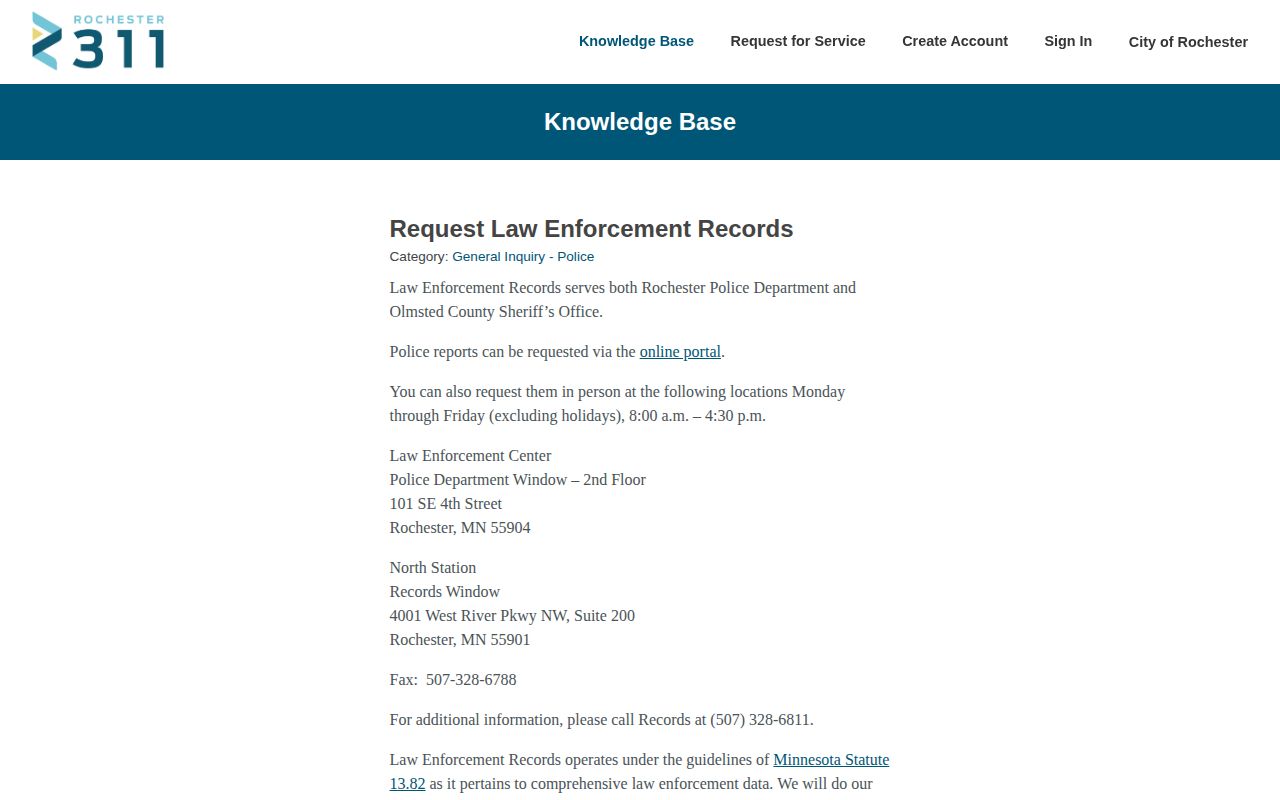
The capture helps identify the correct custodian and response expectations before filing.
Minnesota Arrest Photo and Sealing Law
Public arrest data in Minnesota has limits. Section 13.82 defines which adult arrest data and photos stay open. Active investigations, protected identities, and juvenile classifications can still be withheld. Section 299C.11 and Chapter 609A offer destruction or sealing after certain favorable outcomes. The Clean Slate Act works automatically for eligible records. BCA guidance cautions that sealing does not erase every agency copy at the same time.
Start with the court and the originating agency after a status changes. Send the order or agency confirmation. Ask what remains public. Then request no-fee correction or removal from an unofficial mirror still showing an outdated copy. Search engines may suppress an old result once its source changes. The source itself survives. Minnesota has no anti-pay-to-remove statute or paid-service requirement.
Olmsted Arrest Warrants, Not Most Wanted
The official active-warrant page covers misdemeanor, gross-misdemeanor, and felony warrants but leaves out parking warrants. Searches run on two letters or an initial. A result may list a name, birth date, and warrant count. Olmsted publishes no separate most-wanted gallery. Use the live tool rather than a copied list. Questions go to 507-328-6830, and no one should confront a person on the list. Anyone checking personal status should consult counsel. That person can then contact the court or Sheriff at a published number. The Sheriff warns that callers cannot demand payment by phone to clear a warrant.
This interface is an active-warrant check, not a curated gallery of people.
After an Olmsted County Arrest
Olmsted Court Details bridges arrest and arraignment, showing the arresting agency, date and time, judge, charges, and arraignment results. Arraignment is the early hearing. Charges and release terms get addressed there. Disposition is the later outcome: dismissal, plea, or judgment. The local Court Details application adds procedural facts the custody roster does not contain. MCRO is statewide. Its pending criminal, traffic, and petty-misdemeanor name-search limit means a new booking can predate a name result. A case number, citation, attorney search, or courthouse terminal may help. Court records show how the case ends.
Olmsted Records Across Custody Systems
The VINELink Inmate Check covers custody status and free alerts for participating county jails. VINE is not a photo service. It can lag intake too. The Minnesota DOC Public Viewer applies to state prison or supervision, while Federal Bureau of Prisons and ICE locators are separate systems, so a blank in one answers nothing about the others.
- Booked
- Processed into the county jail after arrest.
- Released
- No longer on a current roster, though records can remain elsewhere.
- Sentenced
- A court imposed punishment; state custody may move the search to MNDOC.
- Disposition
- The court outcome, not the original charge.
Recent Arrests by Olmsted City
Agency coverage drives the route. Rochester runs its own police with a seven-day incident-report index, while Stewartville and Byron contract with the Sheriff, and all three can book someone into the ADC.
- Rochester Recent Arrests: check RPD bulletins and reports, then the ADC and shared records unit.
- Stewartville Recent Arrests: use county roster, activity logs, briefs, and Sheriff records.
- Byron Recent Arrests: keep the source's city or township wording while following county systems.
The Law Enforcement Center page documents contract coverage.
City searches share one jail because every Olmsted arrest can land at the ADC, though the arresting agency differs.
Olmsted Arrest Status Terms
The ADC roster leans on short status labels. “Awaiting Bail or Bond” means release terms are unmet. “Awaiting Arraignment” says the first court appearance has not happened yet. “Awaiting Extradition” may signal a transfer to another jurisdiction. “Lodger” can mean custody for another agency. “Release Revoked” and “Sentenced” mark other grounds. None of these labels gives the final result of every charge.
Read each status beside the booking date. An old booking paired with a current status shows the roster tracks custody. It is not a rolling 24-hour arrest list. Bond is a court-set release condition, not a fine or judgment. The ADC line at 507-328-6790 can explain how the county uses its own fields. Staff may limit what they discuss.
When an Olmsted Arrest Search Fails
A blank result has many causes. The person may not have been booked, or intake may be too new for the next roster update. Release may have already happened, or custody may sit with another county, the state, federal authorities, or immigration officials. Spelling matters too, since a partial-name search can return several people or miss the intended record.
Use a short verification chain. Confirm the exact name and birth date. Call the ADC when safety or release timing matters. Check VINE for custody notification, Court Details for the arraignment bridge, and MCRO for later case data. If those stay blank, send a narrow public-data request. Each step tests a different custody stage, so absence never proves release and a name match never proves identity.
Can an activity-log row confirm an arrest? No. Its time, address, incident number, place, and call type describe reported activity, and only a booking, agency, or court record ties that event to a named person.
Online Roster Versus Olmsted Archives
Current access and historical preservation solve different problems. The ADC roster shifts with custody. Media briefs preserve selected notable events. A records request can retrieve a defined modern record that has left the web, subject to public-data limits. The historical register collection is a paper archive with gaps, not a searchable extension of the current list.
This difference matters after release or sealing. Removal from a public interface does not prove every lawful government copy was destroyed. An old register cannot establish current custody either, so ask which record series is held, what dates it covers, and whether access limits apply.
Historic Olmsted Arrest Records
Today's roster is a working tool, not an archive. Olmsted County's Sheriff traces local jail records back to 1858. The deeper history sits with the state. A Minnesota Historical Society finding aid catalogs 4.5 cubic feet of Sheriff jail registers, including 17 volumes running from 1882 through 1987 with gaps, and the collection is marked open for research. For anyone recently released, the records custodian comes first. Older work may belong with the Historical Society. Narrow by person, date, agency, and incident number.
The finding aid sorts the registers into dated volumes. Spans cover 1882 to 1921, 1919 to 1929, and decade runs through the 1970s. Later volumes handle 1983 and August 1986 through August 1987. Gaps exist, so the catalog cannot promise a register entry for every arrest. The 1858 date on the Sheriff's history page hints that even this large collection is not the whole record universe.
Match the request to the fact you need. A jail register documents admission and confinement. A court file is the better route for disposition. A media brief can explain one incident, while an activity row shows only call context. Access questions about the archival volumes go to the Historical Society. Modern ADC material belongs with the county or joint law-enforcement records unit.
Retention and sealing stay distinct, too. A retention schedule tells an agency how long to hold a record. Expungement is a legal process that restricts access to qualifying records. Neither one means an absent web result never existed.
Official Olmsted Arrest Sources First
Official records should come first in any Olmsted County check. They establish provenance. The ADC roster covers county custody. RPD and OCSO records identify their own incidents. Court Details and MCRO show later procedure within their limits. VINE supplies custody status and notifications. Local reporting adds narrative, but publication is selective and may trail an agency announcement by hours or days.
Third-party booking sites are less dependable. Arrests.org has an Olmsted page, though it returned no useful current results while the ADC roster stayed active. Mugshots.com carries older county material. RecentlyBooked lists no Olmsted section in its Minnesota inventory. Busted Newspaper and Mugshots Zone offer no Minnesota or county section. Those sites change, and none counts as an official arrest record.
When a news report or mirror conflicts with the county, preserve the original date and spelling, then verify with the agency and court. The source, custody window, and update time matter more than how prominent a result looks. Check the agency before trusting a copy.